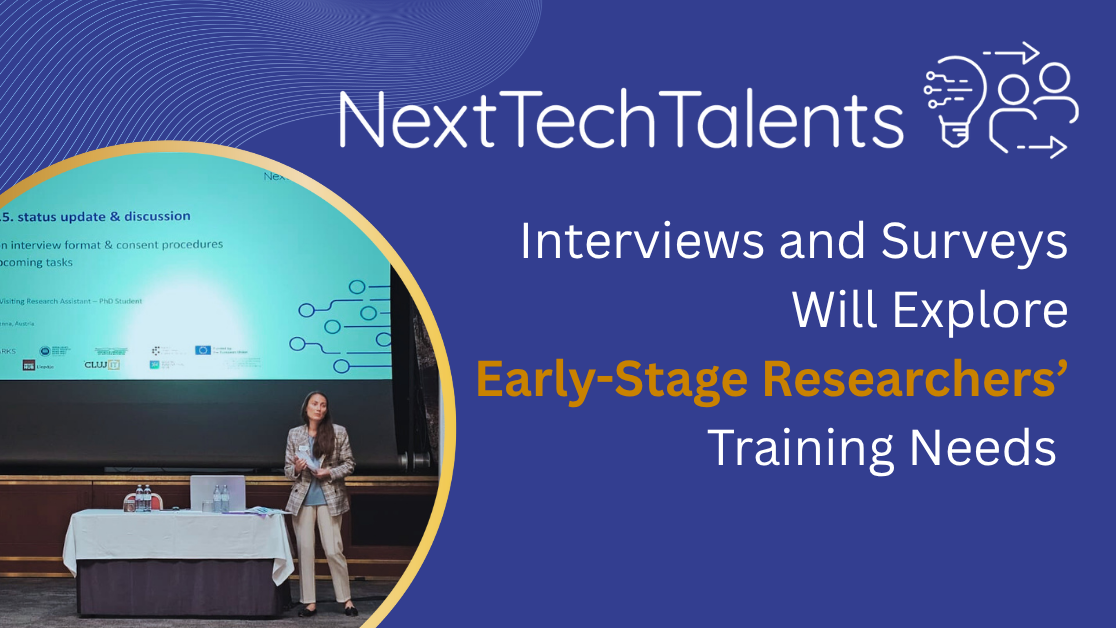



How the Charter for Researchers and ResearchComp can guide modern research careers
This article explains how the European Charter for Researchers[1] and the ResearchComp competence framework can guide the design of modern, sustainable research careers. This is especially important in high‑tech research fields, where organisations compete strongly for talent, innovation moves quickly, and many roles depend on short project grants. Across Europe, many organisations say they follow the principles of the Charter, but practice often differs from place to place and from one institution to another. The strongest research and innovation environments do not treat these documents as abstract policy. Instead, they use them as practical tools to improve working conditions, support career development, and recognise a wider range of contributions so that researchers can progress and stay in the system.
Charter for Researchers and the ResearchComp framework as one guidance system
The main value of using these two instruments together is that they solve different parts of the same problem. The Charter sets the direction by describing what good research careers should look like: fair recruitment, transparent decisions, integrity, equal opportunities, and long‑term sustainability. ResearchComp supports implementation by describing the skills and behaviours researchers need and the ways institutions can help researchers develop them and be recognised for them. When organisations treat the Charter and ResearchComp as one connected system, they are more likely to move beyond formal compliance and achieve real change in daily work. This combined approach also reduces confusion, because broad principles can be translated into clear expectations for supervision, evaluation, training, and organisational processes.
Why high‑tech research changes the “standard” research career model
The revised Charter puts more emphasis on making research careers attractive and sustainable, not only on rights and obligations.[2] This shift matters greatly for fields such as artificial intelligence, biotechnology, and quantum technologies. In these areas, the traditional appeal of academia—freedom to explore ideas, scientific reputation, and the personal motivation to discover new knowledge—is increasingly weighed against job insecurity linked to short, grant‑funded contracts and strong pull from the private sector.[3] This means that “good practice” today is not only about having transparent recruitment rules and clear promotion steps. It is also about ensuring that careers remain realistic and competitive over time, especially for people at the beginning of their careers. Another key change is that high‑tech career paths are rarely straight lines. Researchers often move between laboratories, platforms, start‑ups, established companies, and public organisations. If institutions do not recognise this reality, they risk losing talent. Modern career systems therefore need to support movement between research and innovation environments without treating time outside academia as a failure or a one‑way exit, and without ignoring outputs that are crucial for turning research into real‑world solutions.
Four best practices that show institutional maturity
In this context, four connected best practices can be seen as strong signs that an organisation is ready to support modern research careers. Each best practice links to one of the pillars of the updated Charter and can be made practical through ResearchComp by turning values into skills, behaviours, and fair evaluation criteria. Together, these best practices offer a clear route from policy intentions to measurable improvements that fit the needs of high‑tech research and innovation ecosystems.
-
Build ethics and gender equality into everyday research work
The first best practice is to treat ethics and gender equality as core parts of research quality, not as box‑ticking exercises. The Charter highlights ethics, integrity, and equal opportunities, and these themes are especially important in high‑tech research where societal impact can be direct and large. In strong organisations, “ethics by design” is built into the whole research process. It starts with how researchers define the problem and choose data, continues with decisions made during modelling and testing, and includes thinking ahead about how results might be used. In artificial intelligence work, for example, researchers are increasingly expected to notice and reduce unfair bias, consider who might be harmed by a system, and explain how they make technical decisions in a responsible way.
Gender equality has also moved forward in the most mature settings. Strong practice goes beyond reporting how many women and men are in a team. It treats equality as a real operational topic, for instance by planning budgets in ways that support equal opportunities and by systematically considering gender in research content where it is relevant, in line with expectations that are increasingly common in European research funding. Early signals suggest that similar expectations are beginning to influence national programmes in some countries as well. The common weakness is that ethics and equality still sit outside the real machinery of research: supervision, evaluation, and governance. A practical improvement is to require each project to show clear evidence of ethics and gender considerations in internal reviews and supervision milestones, and to treat these as skills that researchers develop and are assessed on, not as optional extras.
-
Make recruitment and career progression fair, open, and fit for modern research outputs
The second best practice is to modernise recruitment and career progression so they reflect how high‑tech research creates value. The Charter’s principles on recruitment and progression are central here. High‑tech research often produces outputs that traditional academic assessment does not reward enough, such as software, well‑prepared datasets, prototypes, contributions to technical standards, and serious engagement with users, policymakers, or communities. If these outputs are ignored, institutions discourage the exact behaviour that helps research become innovation.
Strong practice uses open, transparent, and merit‑based recruitment with clear criteria and consistent procedures. It also follows the wider European direction towards responsible research assessment, which encourages moving away from narrow scoring systems and towards richer evaluation of real contributions.[4] In practical terms, many advanced organisations use narrative curriculum vitae formats,[5] where researchers explain what they contributed, why it matters, and what they learned. This makes space to recognise data stewardship, software development, teamwork, and societal impact alongside publications. The main barrier is cultural. In some places, simple counting metrics remain popular because they feel objective and easy to administer, especially where resources are limited. A realistic improvement is to introduce a shared narrative curriculum vitae template across partners and to require evaluation panels to state clearly how they assessed outputs such as software, datasets, and collaboration with industry. Training for evaluators is important, because people need confidence and shared standards to make fair qualitative judgements.
-
Improve stability with continuity funding and new long‑term career roles
The third best practice is to reduce job insecurity by building continuity into the system. The Charter explicitly addresses working conditions and stability, and this becomes urgent in high‑tech research. Many high‑tech projects require long learning periods, expensive infrastructure, and complex experimental cycles. If researchers are repeatedly pushed into short contracts with gaps between projects, institutions lose capability just when it becomes valuable.
Advanced organisations use continuity tools such as bridging funds that help retain strong researchers between grants. These funds are often supported by institutional resources and are designed to prevent talent loss when expertise is growing. Mature ecosystems also create long‑term roles that sit between purely academic and purely administrative work. These roles focus on areas such as research project management, infrastructure stewardship, data governance, technology transfer, and cooperation with companies. Such roles are increasingly essential for high‑tech environments where research needs to connect to real‑world testing and adoption. Another stabilising approach is to employ doctoral candidates as staff with full social security rather than treating them as scholarship holders, which can make early career stages more secure and attractive. The structural challenge remains that many national systems rely heavily on short project funding, and in some settings legal limits on repeated fixed‑term contracts can force researchers out when permanent roles are scarce. A practical improvement is an institutional continuity policy that defines when bridging support is possible, sets out these long‑term hybrid roles, and clarifies transparent routes from doctoral training to postdoctoral and independent research roles, supported by clear skill development and supervision standards.
-
Support movement between academia and industry through clear skills development
The fourth best practice is to make movement between academia and industry a normal and valued part of research careers. The Charter treats mobility as important for career development, and this is especially true in high‑tech fields where translation and scale‑up often happen outside universities. In mature systems, time spent in companies is not seen as a career break or a one‑way exit from academia. Instead, organisations use policies that allow researchers to take industry placements and return without losing career momentum.
ResearchComp is particularly useful here because it gives a clear structure for skills development and assessment. For high‑tech careers, it also helps describe the gap between general research skills and the skills needed for high‑tech innovation.[6] In advanced practice, institutions use ResearchComp to design training and supervision that build practical problem‑solving under uncertainty, strong data management in line with the principles that data should be findable, accessible, interoperable, and reusable, and modern research management methods that match faster innovation cycles.[7] ResearchComp also helps highlight weak points that many doctoral programmes still struggle with, such as innovation skills, entrepreneurship, and managing intellectual property. Without support in these areas, researchers may publish too early and lose the chance to protect and develop inventions. Strong practice therefore includes mentoring and support for wellbeing and resilience, because high‑tech research often involves failure, long iteration cycles, and pressure to perform.[8] Another strong sign of maturity is the presence of partners that connect research training with real‑world needs, such as innovation hubs or technology support organisations that offer test environments and practical learning through collaboration and co‑location. These “translation layers” help ensure that cross‑sector experience leads to recognised skills and real outputs, not just time spent outside the university.
Closing observation: moving from formal alignment to real change
Together, these four best practices describe a clear pathway from formal alignment to systemic maturity. The Charter for Researchers provides shared principles for fair, attractive, and sustainable research careers, while ResearchComp provides a practical way to turn those principles into skills, development actions, and evaluation criteria. The strongest ecosystems build values into everyday research practice, modernise evaluation to recognise the full range of high‑tech contributions, reduce job insecurity through continuity mechanisms, and make movement between academia and industry feasible and rewarded. Used together in a measurable, skills‑based way, the Charter and ResearchComp offer institutions a practical route to strengthen the attractiveness, sustainability, and cross‑sector compatibility of research careers across Europe.
Keywords
European Charter for Researchers; European Research Area; research careers; early‑stage researchers; high‑technology research; ethics by design; research integrity; gender equality; fair recruitment; transparent recruitment; merit‑based selection; responsible research assessment
References
[1] Council of the European Union, “Council Recommendation of 18 December 2023 on a European framework to attract and retain research, innovation and entrepreneurial talents in Europe,” Official Journal of the European Union, Series C, no. 2023/1640, Dec. 2023.
[2] Atomico, “State of European Tech 2024,” Atomico, London, U.K., 2024. Accessed: Dec. 18, 2025. [Online]. Available: https://stateofeuropeantech.com/
[3] Coalition for Advancing Research Assessment (CoARA), “Agreement on Reforming Research Assessment,” CoARA, Brussels, Belgium, 2022. Accessed: Dec. 18, 2025. [Online]. Available: https://www.coara.org/agreement/the-agreement-full-text/
[4] Coalition for Advancing Research Assessment (CoARA), “Agreement on Reforming Research Assessment,” CoARA, Brussels, Belgium, 2022. Accessed: Dec. 18, 2025. [Online]. Available: https://www.coara.org/agreement/the-agreement-full-text/
[5] Research on Research Institute (RoR), The experimental Research funder’s handbook (2nd edition). RoR Institute, London, U.K., 2023.
[6] C. Whitchurch, “The Rise of Third Space Professionals: Paradoxes and Dilemmas,” in Forming, Recruiting and Managing the Academic Profession, U. Teichler and W. C. Cummings, Eds. Cham, Switzerland: Springer, 2015, pp. 79–99.
[7] European Commission, Directorate-General for Research and Innovation, “ResearchComp: The European Competence Framework for Researchers”, Publications Office of the European Union, Luxembourg, 2023. Accessed: Dec. 18, 2025. [Online]. Available: https://research-and-innovation.ec.europa.eu/jobs-research/researchcomp-european-competence-framework-researchers_en;
Leijon, P. Gudmundsson, P. Staaf, A. Christersson, “Challenge based learning in higher education – A systematic literature review”. Innovations in Education and Teaching International, vol. 59, no. 5, pp. 609–618, 2022;
D. Wilkinson et al., “The FAIR Guiding Principles for scientific data management and stewardship”. Scientific Data, vol. 3, art. no. 160018 (2016);
Franco et al., “Introducing ScrumAdemia: An Agile Guide for Doctoral Research”. PS: Political Science & Politics, vol. 56, no. 2, pp. 251–258 (Apr. 2023).
[8] K. Levecque et al., “Work organization and mental health problems in PhD students”. Research Policy, vol. 46, no. 4, pp. 868–879 (May 2017).