


Europe’s AI Future in Action: Skills, Talent and the Future of Work at Cluj Innovation Days
As the European Union transitions from AI strategy to implementation, the focus is no longer only on regulation or investment, it is on people. With the Artificial Intelligence Act entering its application phase and the AI Continent Action Plan accelerating infrastructure, investment and innovation, Europe’s AI agenda is increasingly centred on one critical question: does Europe have the skills and talent to lead in trustworthy AI?
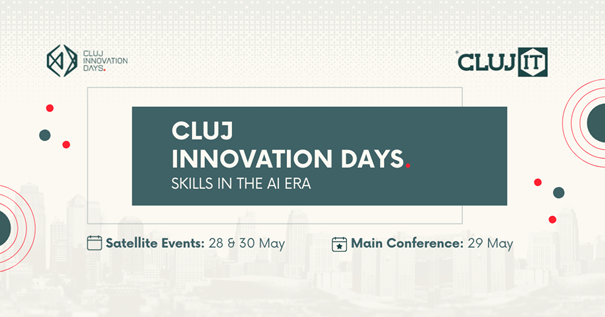
Cluj Innovation Days
The 14th edition of Cluj Innovation Days, themed “Skills in the AI Era,” is taking place on May 28–29 in Cluj-Napoca, Romania and captures the EU’s shift from AI strategy to applicable implementation, with a strong focus on the competences that will define Europe’s competitive edge in deep tech and artificial intelligence. More than a policy update, the conference demonstrates how initiatives such as the AI Act, AI Factories, and InvestAI apply to people: researchers, entrepreneurs, innovators, and SMEs who transform regulation, funding, and infrastructure into a positive impact. This edition places skills, talent, and future-ready capabilities at the very centre of the conversation.
Through thematic sessions such as “AI for Society: Opportunities, Risks and Skills Europe Needs” and “AI and the Future of Work: Skills, Jobs and Europe’s Talent Transformation,” participants engage in innovative discussions on anticipating skills gaps, fostering reskilling, and supporting emerging career pathways. The agenda links digital infrastructure and innovation with scientific excellence, digital fluency, and essential transferable skills. It also highlights how talent can circulate more across academia, industry, and the public sector. What makes this edition particularly aligned with the EU agenda is its strong hands-on dimension.
More than a conference, Cluj Innovation Days is a meeting point for policymakers, researchers, companies and innovation enablers committed to shaping Europe’s digital future. By turning strategic priorities into dialogue on training systems, mentoring and cross-sector collaboration, the event helps build a resilient talent ecosystem that powers a stronger, smarter and more competitive European Research Area.
NextTechTalents: Enabling AI-Ready Researchers
Within this ecosystem, NextTechTalents, funded under Horizon Europe, plays a very important role in strengthening Europe’s deep tech and AI workforce.
The NextTechTalent project addresses a thorny challenge: early-stage researchers often lack exposure and access to industrial collaboration, regulatory frameworks, entrepreneurship, and cross-sector mobility. In fast-evolving fields such as AI and deep tech, this gap can limit both employability and innovation impact. By developing a modular training system aligned with ResearchComp and EU standards, NTT equips researchers with: Advanced AI and digital competences, Entrepreneurial and commercialisation skills, Interdisciplinary collaboration capabilities, and Mobility pathways between academia and non-academic sectors. This directly supports the EU’s goal of creating a sustainable talent ecosystem capable of translating R&D into economic and societal value.
Thus, Cluj Innovation Days demonstrates how EU policies trickle down into regional projects addressing gaps in national and local policies, and how the industry and academia can collaborate to enhance the EU strategic vision. Sessions on the future of work are key to promoting Europe’s skills agenda. The Skillab Testathon and open-source workshop demonstrates how experimentation and collaboration between different actors, such as policymakers, researchers, companies and innovation enablers, can contribute to change.
NextTechTalents contributes to the EU agenda by ensuring that early-stage researchers are not only technically skilled but also mobility-ready, compliance-aware, and innovation-oriented. The conference highlights a central truth of Europe’s AI agenda: AI leadership will not be achieved by regulation or funding alone. It will be secured through people — equipped with advanced skills, grounded in European values, and ready to shape the future of work.
Links
Cluj Innovation Days 2026: https://clujinnovationdays.com/
The EU Artificial Intelligence Act: https://artificialintelligenceact.eu/
AI Factories: https://digital-strategy.ec.europa.eu/en/policies/ai-factories
EU launches InvestAI initiative to mobilise €200 billion of investment in artificial intelligence:
ResearchComp: European Competence Framework for Researchers:
Further readings:
Public sector AI readiness: closing the gap between ambition and execution in Europe
Impact of digitalisation: 30% of EU workers use AI
How Europe Can Survive the AI Labor Transition
Europe’s AI Workforce: Mapping the Talent Behind the Code
Artificial Intelligence and the Future of Work
https://ec-europa-eu.libguides.com/ai-and-future-work/eu-publications/selected
Keywords
Research, Skills, Academia, Industry, Policy, Reskilling, Upskilling, Mentoring, Academic-Industry Collaboration, AI Regulation, EU Strategy, DeepTech, Early-stage Researchers, Tech Entrepreneurship