From Planning to Practice: Rolling Out the NextTechTalents Training System Across Europe
How can a researcher training system move from design into everyday practice? NextTechTalents is taking this next step by supporting organisations across Europe to implement, test and refine a common approach to competence and career development for early-career researchers.
The NextTechTalents Training System provides a structured approach to developing the competences early-career researchers need for careers within and beyond academia. Through its Implementation Roadmap and pilot activities across Europe, the project is moving from planning to practice, providing organisations with a structured framework to assess existing provision, identify gaps, implement appropriate activities and continuously improve researcher development within their own institutional and regional contexts.
Early-career researchers are developing their careers in an increasingly diverse research and innovation environment. Alongside disciplinary and methodological expertise, they need opportunities to develop broader competences that support communication, collaboration, project management, digital working, innovation and career development across academic and non-academic settings.
The NextTechTalents Training System responds to this need through a competence-based approach aligned with ResearchComp, the European Competence Framework for Researchers [1] and complemented by competences relevant to Deep Tech environments. Training and development activities are organised across six thematic strands: Research Excellence and Methods; Data, Digital and Open Science; Managing Research and Projects; Innovation, Impact and Intersectoral Transition; Communication, Collaboration and Public Engagement; and Self-management, Resilience and Career Development [2].
But developing a Training System is only part of the challenge. Organisations also need practical guidance on how to integrate it with existing researcher-development activities, engage the right people and external partners, deliver appropriate training and mentoring, and determine what works in different institutional settings.
This is where the NextTechTalents Implementation Roadmap comes in. Rather than prescribing a single model for every organisation, the roadmap provides a common step-by-step implementation framework that can be adapted to different organisational and regional contexts. It enables institutions to build on what they already have, identify gaps in existing provision and introduce or adapt activities where they can add the greatest value [4].
A practical roadmap for implementation
Putting a training system into practice requires more than selecting courses and inviting participants. Organisations need to understand what they already provide, where gaps exist, who needs to be involved and how new activities can be integrated into existing researcher-development structures.
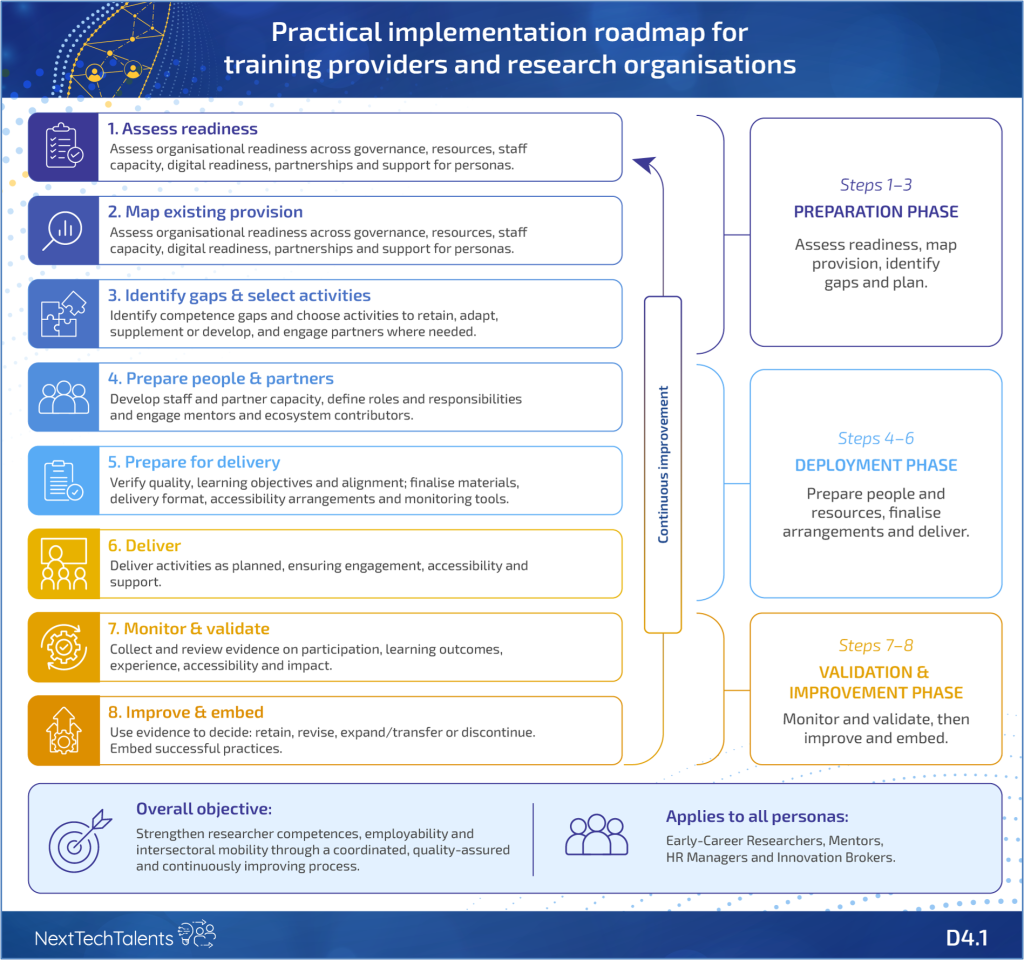
The roadmap translates this challenge into eight practical implementation steps, organised within three connected WP4 pilot phases: Preparation, Deployment, and Validation & Improvement. The Preparation Phase focuses on assessing organisational readiness, mapping existing researcher-development provision, identifying gaps and selecting appropriate activities. The Deployment Phase involves preparing the people, resources and arrangements needed for implementation, followed by the delivery of selected activities. Finally, the Validation & Improvement Phase uses evidence from participation, learning outcomes, accessibility and participant experience to evaluate activities and determine what should be retained, revised, expanded, transferred, replaced or discontinued.
Importantly, the approach does not require organisations to start from scratch. Existing courses, workshops, mentoring programmes and career-development services can be mapped against the NextTechTalents Training System. Activities that already meet identified needs can be retained, while others can be adapted, supplemented, newly developed or delivered with support from external partners. This allows organisations to concentrate resources on genuine competence and career-development gaps rather than duplicating existing provision.
The final stage also connects back to the beginning of the roadmap through a continuous improvement cycle. Evidence collected during implementation is intended to inform decisions about future delivery and the longer-term embedding of successful practices. In this way, implementation becomes an ongoing process of testing, learning and improvement rather than a one-off training exercise.
More than training: building a talent ecosystem
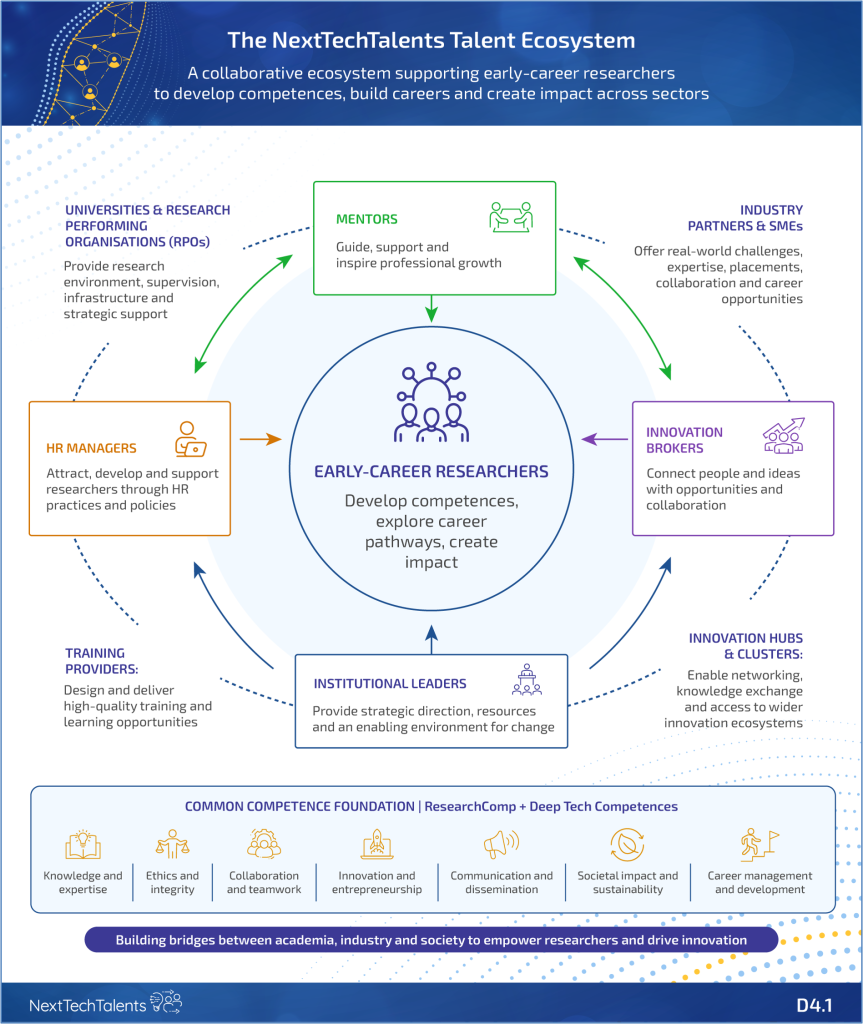
Effective researcher development does not happen through training alone. The NextTechTalents approach brings together early-career researchers, universities and research organisations, mentors, HR professionals, innovation brokers and industry partners within a wider talent ecosystem. Each stakeholder group has a role in creating the conditions in which researchers can develop their competences, explore different career pathways and build connections beyond their immediate research environment.
Within this ecosystem, Early-Career Researchers participate in training, mentoring and career-development activities and provide feedback on their needs and experiences. Mentors support professional and career development, while HR Managers can help connect competence development with recruitment, researcher assessment and institutional career-development practices. Innovation Brokers play an important bridging role, connecting researchers with industry, innovation networks and opportunities for collaboration, mobility and knowledge exchange [3].
Non-academic organisations are equally important. Companies, SMEs, start-ups, innovation hubs and other ecosystem partners can contribute real-world expertise and challenges, participate in training and mentoring, and expose researchers to different professional environments. Their involvement can range from relatively light-touch expert contributions to jointly delivered activities and more substantial forms of intersectoral mobility and collaboration.
By connecting these different actors, NextTechTalents aims to create researcher-development opportunities that extend beyond traditional academic training. Researchers can develop competences while also gaining greater awareness of how their knowledge and skills can be applied across academic, industry and hybrid career pathways.
Diversity, equality and inclusion are also important considerations throughout implementation, including inclusive recruitment, accessible participation and activities designed to address barriers to researcher development and career progression.
Putting the approach to the test across Europe
The next stage is to move the NextTechTalents approach from the roadmap into real-world implementation. Through WP4, the Training System will be implemented and tested across four pilot hubs: Munster Technological University (MTU) in Ireland, Jožef Stefan Institute (JSI) in Slovenia, Babeș-Bolyai University (UBB) in Romania, and Ventspils University of Applied Sciences (VUAS) in Latvia [4].
The pilots provide an opportunity to explore how the Training System can work across different organisational and regional contexts. Rather than simply measuring whether activities have been delivered, the aim is to assess their relevance, usability, feasibility and potential for wider adoption. Evidence and feedback gathered during the pilots will be used to identify what works well, what requires improvement and how the NextTechTalents approach can be refined as implementation progresses.
Implementation combines different forms of learning and development. The Training System uses expert-led webinars and lectures, hands-on workshops, self-paced learning resources, and mentoring and coaching [2]. These formats are intended to complement one another: webinars can introduce knowledge and ideas, workshops provide opportunities for practical application and peer learning, self-paced resources offer flexible access to learning, and mentoring helps researchers relate their development to their individual careers and professional goals.
This pilot approach is important because successful implementation is unlikely to look the same everywhere. Institutions differ in their existing training provision, staff capacity, digital infrastructure, available resources and relationships with external partners. NextTechTalents therefore provides a common framework while allowing practical delivery to be adapted to local circumstances.
The experience generated across the four pilot hubs will help identify not only what works, but also what needs to change for the approach to work in different settings. This learning will provide an important foundation for refining the Training System and supporting its potential wider adoption beyond the initial NextTechTalents pilot organisations.
Learning, improving and looking ahead
Delivering training is not the end of the implementation process. A central feature of the NextTechTalents approach is the use of evidence and participant feedback to understand how activities perform in practice and how they can be improved over time.
During implementation, participating organisations will consider factors such as participation, engagement, achievement of learning outcomes, workload, accessibility, technical issues and the involvement of mentors and external contributors. Participant feedback will provide further insight into the relevance of activities to researchers’ career and competence-development needs, the effectiveness of different delivery formats and opportunities for improvement. Interactive audience-response and feedback tools can also support this process. For example, tools such as Vevox, Mentimeter or equivalent platforms can be used during training to gather real-time feedback on clarity, relevance, pace and interaction, allowing trainers to adjust delivery where appropriate. End-of-activity feedback provides an additional opportunity to assess participant experiences and identify improvements, with the combined evidence contributing to the wider validation of training activities.
Importantly, feedback is not being collected simply for reporting purposes. The evidence generated through implementation will inform practical decisions about what happens next. Activities may be retained, revised, expanded or transferred to other settings, or replaced or discontinued where they do not provide sufficient value [4]. Successful approaches can then be integrated into existing mentoring programmes, researcher-development services, HR practices or partnerships with external organisations.
This creates a continuous cycle of implementation, feedback, validation and improvement. It also allows NextTechTalents to learn from differences between participating organisations and regional ecosystems, helping to identify which elements can be readily transferred and where adaptation may be necessary.
Ultimately, moving from planning to practice is about more than delivering a programme of training activities. It is about developing a practical and adaptable approach that organisations can use to strengthen researcher development over the longer term. By combining a common competence framework with practical implementation guidance, diverse learning formats, cross-sector collaboration and continuous improvement, NextTechTalents is working towards a more connected and sustainable talent ecosystem for early-career researchers.
References
[1] European Commission – ResearchComp: The European Competence Framework for Researchers
[2] NextTechTalents – D3.2 Training System and Curricula with Focus on Early-stage Researchers
[3] NextTechTalents – D3.3 Implementation Handbook
[4] NextTechTalents – D4.1 Implementation Roadmap for Training Provider Organisations and Non-Academic Stakeholders
Keywords
NextTechTalents, early-career researchers, researcher development, ResearchComp, Deep Tech, training, transferable competences, talent ecosystem, career development, intersectoral mobility, mentoring, diversity, equality and inclusion, research careers